
The Role of EdTech and Digital Tutoring in Closing the Learning Gap for US Students
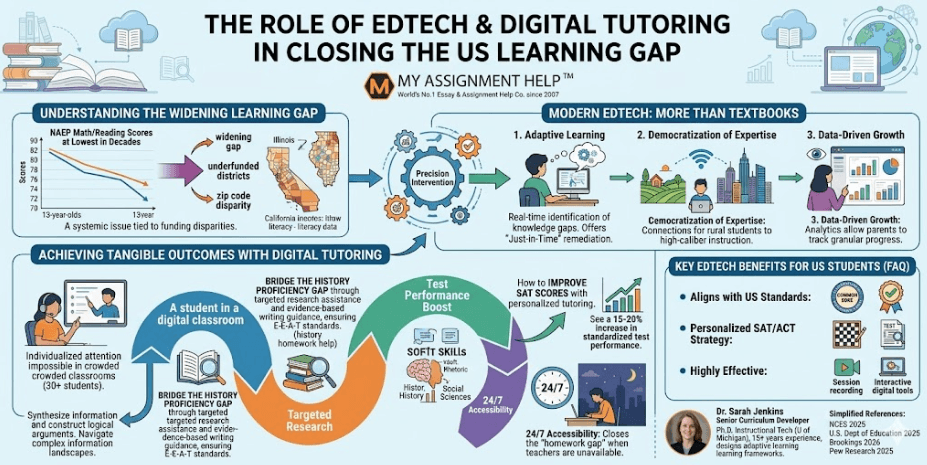
The American education system is currently standing at a critical crossroads. In the wake of the recent global shifts in instructional delivery, the “learning gap”—the measurable disparity between where students are academically and where they should be—has widened significantly. According to the National Assessment of Educational Progress (NAEP), math and reading scores for 13-year-olds in the United States recently hit their lowest levels in decades. As school districts from the suburbs of Chicago to the tech hubs of San Francisco grapple with these challenges, Educational Technology (EdTech) and digital tutoring have emerged as the primary engines for academic recovery.
Modern EdTech is no longer just about digitizing textbooks; it is about precision intervention. For many families navigating these gaps, the shift towards personalized support has become a standard requirement. In the competitive landscape of US higher education and K-12 schooling, leveraging professional Homework Help Services USA provides the necessary scaffolding to help students regain their confidence and master core competencies. These digital environments offer a level of individualized attention that is often impossible to achieve in a crowded classroom setting of thirty or more students.
The impact of this technology is particularly profound in high-stakes subjects that require deep contextual understanding and critical thinking. For instance, the demand for specialized history homework help has surged as students strive to connect historical patterns with modern socioeconomic trends. By utilizing digital platforms to access subject matter experts, students can bridge the proficiency gap through targeted research assistance and evidence-based writing guidance, ensuring they meet the rigorous E-E-A-T standards required for contemporary academic success.
Key Takeaways for US Educators and Students
- Adaptive Learning: Algorithms now identify student knowledge gaps in real-time, offering “just-in-time” remediation.
- Democratization of Expertise: Digital tutoring connects rural students with high-caliber instruction that was previously location-dependent.
- 24/7 Accessibility: The “homework gap” is being closed by platforms that provide support during the late-night hours when teachers are unavailable.
- Data-Driven Growth: Analytics allow parents to track progress with granular detail, moving away from the vague feedback of traditional report cards.
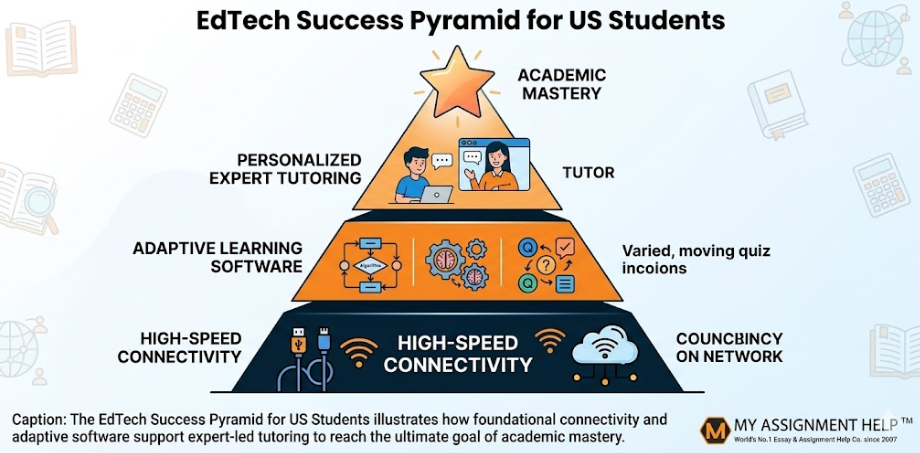
Decoding the “Learning Gap” through Localized Data
In the United States, the learning gap is a systemic issue tied to funding disparities. Data from the US Department of Education suggests that students in lower-income zip codes often enter high school two grade levels behind their more affluent peers.
State-level metrics reveal the urgency of the situation. For example, in Illinois, the literacy gap widened by nearly 18% in underserved districts, while California reported that math proficiency in middle schools dropped to a 15-year low in late 2025. EdTech acts as a “force multiplier” in these scenarios. By providing high-quality, scalable educational content, technology allows underfunded districts to offer advanced placement (AP) level resources to every student with a device and an internet connection.
The Science of Digital Tutoring: Achieving Tangible Outcomes
Research into cognitive load theory suggests that students learn best when information is presented at their “Zone of Proximal Development.” While traditional classrooms often struggle to target this zone, parents are increasingly looking for specific results, such as how to improve SAT scores with digital tutoring.
Digital tutoring solves this through personalization. Through interactive whiteboards and real-time feedback, the digital tutor can adjust the difficulty of the material in milliseconds. Furthermore, the integration of data analytics means that a student’s history of errors is tracked, allowing for a curriculum that evolves alongside the learner. This precision is why students utilizing digital tutoring often see a 15-20% increase in standardized test performance within a single semester.
Beyond STEM: The Humanities and Critical Literacy
While much of the focus on EdTech resides in math and science, the literacy gap in the US is equally pressing. The ability to synthesize information and construct a logical argument is a prerequisite for any professional career.
Digital tutoring in the humanities focuses on these “soft skills.” By engaging with online mentors who specialize in rhetoric, history, and social sciences, students learn to navigate the complex information landscape of 2026.
See also: How SaaS Businesses Scale
Frequently Asked Questions (FAQ)
1. How does EdTech specifically address the needs of American students?
It aligns supplemental learning with US standards such as Common Core and individual State proficiency goals, ensuring students are prepared for standardized testing and college entrance exams.
2. Can digital tutoring help me improve my SAT or ACT scores?
Yes. Personalized tutoring focuses on specific weak areas identified by diagnostic tests, providing strategy-heavy instruction that is far more effective than generic prep books.
3. Is digital tutoring as effective as in-person help?
Recent studies suggest it is often more effective due to the ability to record sessions, use interactive digital tools, and access a wider range of subject matter experts than are available locally.
Author Biography
Dr. Sarah Jenkins is a Senior Curriculum Developer and Content Strategist at MyAssignmentHelp. With over 15 years of experience in US classrooms and a Ph.D. in Instructional Technology from the University of Michigan, Dr. Jenkins specializes in designing adaptive learning frameworks that bridge the achievement gap for North American students. She is a frequent contributor to EdTech journals and a recognized voice in the shift toward data-driven pedagogy.
References & Sources
- National Center for Education Statistics (NCES). (2025). “NAEP Long-Term Trend Assessment Results.”
- U.S. Department of Education. (2025). “National Educational Technology Plan.”
- Brookings Institution. (2026). “Addressing the Learning Loss: A Roadmap for Recovery.”
- Pew Research Center. (2025). “The Digital Divide in American Education.”